

Premium project-based curriculum · Entrepreneurship
Pitch to
Profit
Find a real problem. Build the fix. Make a first real sale.
For grades 7–12 · Entrepreneurship for the AI Age · 18 weeks
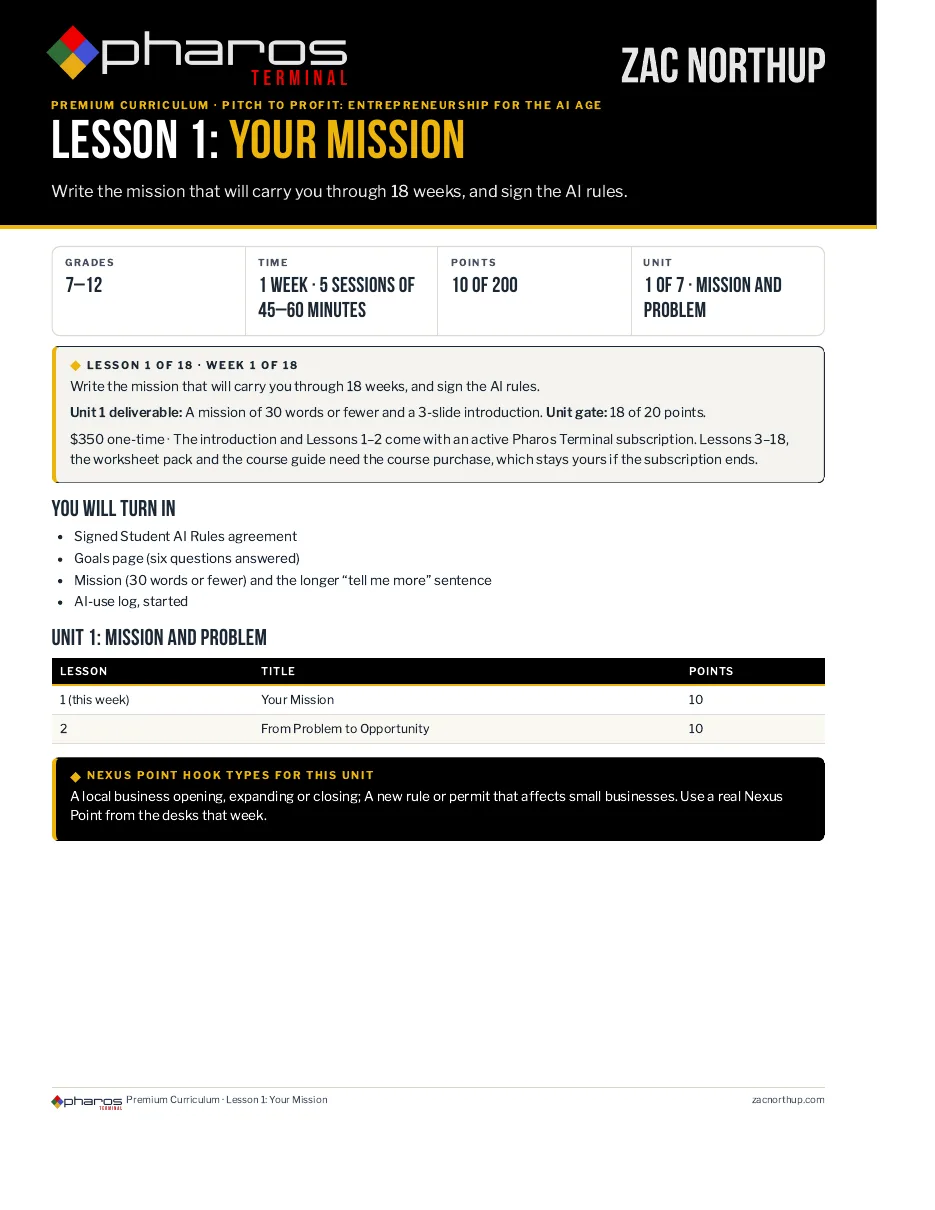
Lesson 1, page 1. The introduction and Lessons 1–2 are included with an active Pharos Terminal subscription.
One idea.
A real sale.
- 18 weeksOne lesson a week, about five sessions of 45–60 minutes.
- 7 unitsFrom mission and problem to the launch paperwork.
- 15+ interviewsCustomer discovery with real people, and a survey.
- Five briefs3 slides, then 2, 5, 8 and 10 minutes, then the capstone.
- A real saleThe course is finished when a real customer pays.
Two ways to work
Online or on paper.
Or both.
Every purchase includes every lesson, the worksheet pack and the course guide as PDFs. Pharos Terminal subscribers also work the course online.
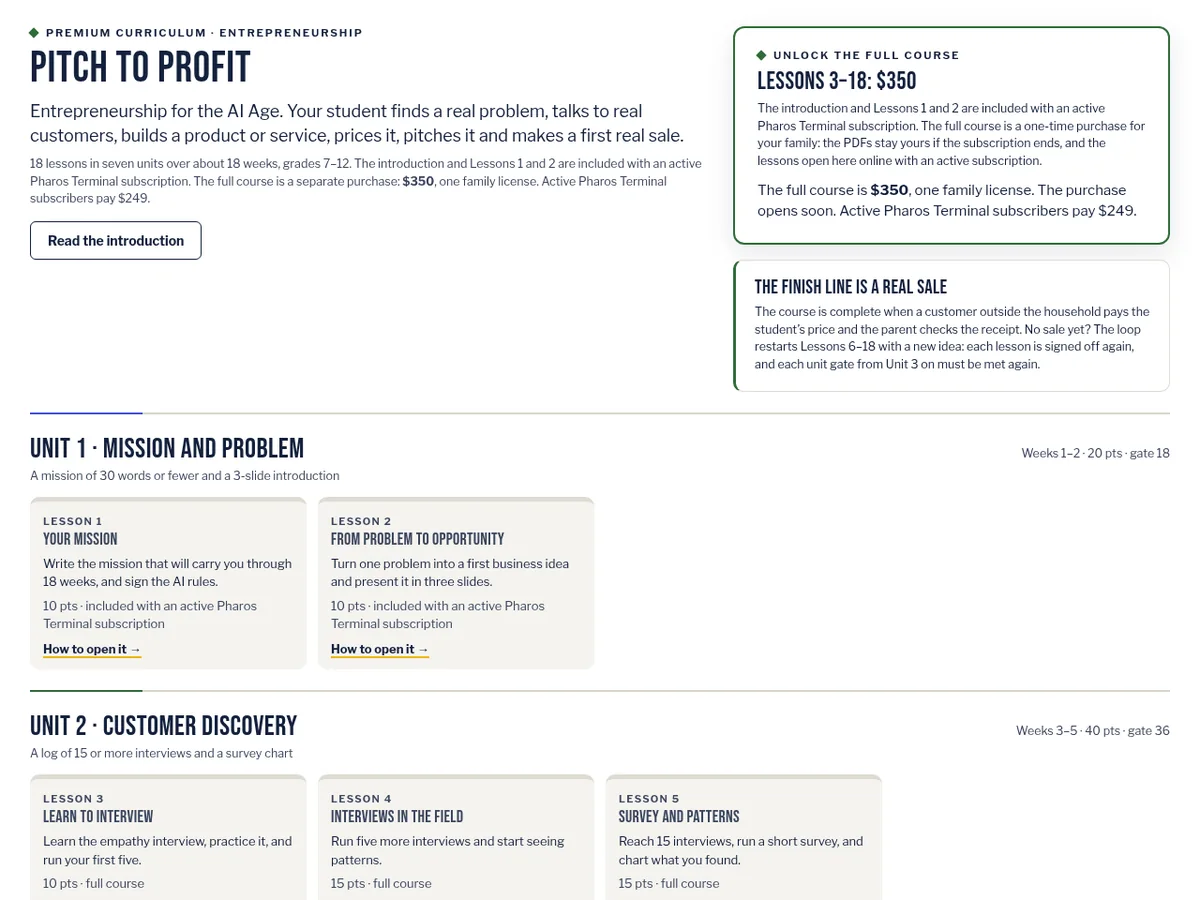
Online · For Pharos Terminal subscribers
In Pharos Terminal
The course inside Pharos Terminal, with the parent’s sign-off on every lesson.
- The introduction and Lessons 1–2 included with an active Pharos Terminal subscription.
- Enter each lesson’s score and sign it off in Pharos Terminal.
- Sign-offs, scores and uploaded work are kept in your family’s private Pharos Terminal storage.
- Each unit pairs with a type of current event from the Nexus Point desks.
PDF · Included with every purchase
The course PDFs
The introduction, all 18 lessons, the worksheet pack and the course guide, yours to keep.
- Print them, or read them on any device.
- A part “For the parent or teacher” in every lesson: what to look for and when to sign off.
- A scoring table in every lesson: 200 points across seven units.
- The briefing rubric, the AI rules agreement and the sale record.
- The purchase stays yours if the subscription ends.
Left: the course in Pharos Terminal. Right: Lesson 1, page 1, as it appears in the PDF.
The course
Seven units. Eighteen weeks.
Each unit ends with something real: a mission, interviews, a prototype, the numbers, a pitch and the paperwork.
- Weeks 1–2Lessons 1–2Mission and Problem. A mission of 30 words or fewer and a 3-slide introduction.
- Weeks 3–5Lessons 3–5Customer Discovery. A log of 15 or more interviews and a survey chart.
- Week 6Lesson 6Stay or Pivot. A 2-minute brief with three reasons from the evidence.
- Weeks 7–9Lessons 7–9Prototype and Brand. A prototype or service catalog, a logo, a one-page site and feedback from 5 people.
- Weeks 10–12Lessons 10–12Revenue Model. A cost sheet, a breakeven and a six-month projection.
- Weeks 13–16Lessons 13–16Script and Briefings. 5-, 8- and 10-minute briefs, a script and a rehearsal and AI-use log.
- Weeks 17–18Lessons 17–18Launch Paperwork. A start-up worksheet, the capstone pitch, a launch dossier and a first sale.
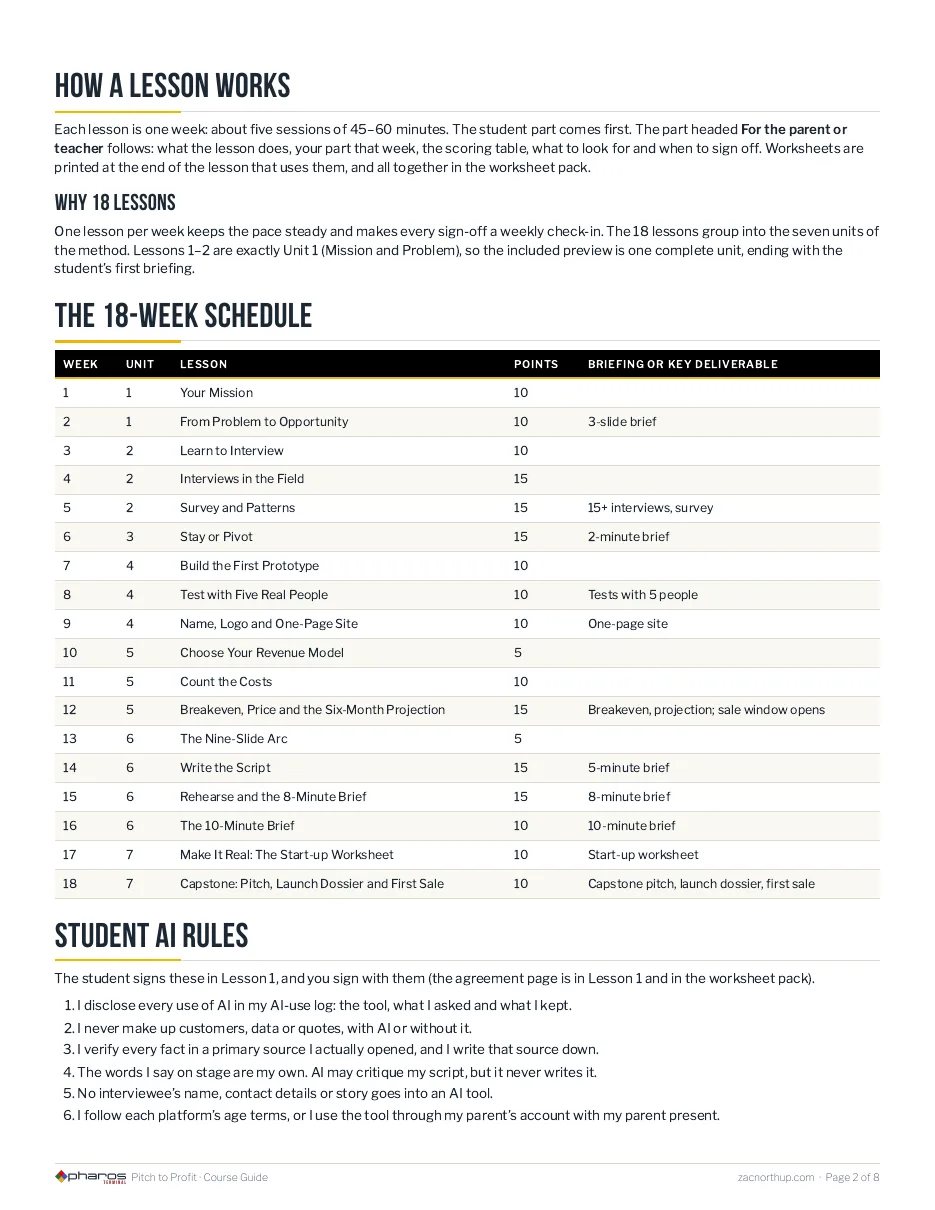
Every lesson
Eighteen lessons.
Each lesson is one week. A student needs 90% of a unit’s points before the next unit opens.
The capstone
Pitch it live.
Then sell it.
Ten minutes, from memory, live to an audience of 30 or more that includes three or more local business owners, then questions.
Included with an active Pharos Terminal subscription
Start with Unit 1.
An active Pharos Terminal subscription includes the introduction and Lessons 1–2: one complete unit, ending with the student’s first briefing. Buy the full course for Lessons 3–18, the worksheet pack and the course guide.
AI is an assistant
Never the author.
The student and a parent sign the AI rules in Lesson 1. Every fact is checked in a primary source the student actually opened.

Your guide
Zac Northup
Zac has written and published under his own name since 1996. From 2016 to 2021, he ran an educational nonprofit that taught rural high school students to launch their own small businesses. He holds an M.A. in History from the University of North Carolina Wilmington.
Pricing
The whole course.
One payment.
No subscription needed.
Included
- The introduction and all 18 lessons as PDFs
- The worksheet pack
- The course guide with the 18-week schedule
- The briefing rubric, AI rules agreement and sale record
Not included
- Prototype materials, on a budget your family sets
- A capstone venue and transportation
- Any business registration or fees
- Legal or tax advice
Pharos Terminal subscribers: $249 — the full course at the subscriber price.
Pharos Terminal is $399 a year for one student ($299 for each additional student) and includes the introduction and Lessons 1 and 2. Refund policy
Questions? Answers.
Who is it for?
Students in grades 7–12. It is one track for every grade, with a parent or teacher scoring and signing off each lesson.
Do we need a Pharos Terminal subscription?
No. On its own, the full course will be $350 for every lesson, the worksheet pack and the course guide as PDFs. Active Pharos Terminal subscribers will pay $249. The introduction and Lessons 1–2 are included with an active subscription.
What counts as a real sale?
Money paid by a customer outside your household, at your price, for your product or service, with a receipt your parent checks. Gifts, family purchases and money you lend someone to buy from you do not count.
What if there’s no sale?
No sale is not a failure; it is evidence. The student goes back to Lesson 6, writes at least three new or revised ideas, runs five more interviews and works Lessons 6–18 again with the new idea. Lessons 1–5 keep their scores. The course is complete at the first real sale.
How is AI used?
As an assistant, never the author. Every use goes in the AI-use log. No interviewee’s name, contact details or story goes into an AI tool, and students follow each platform’s age terms or use the tool through a parent’s account with the parent present.
What does the parent do?
Chaperone interviews and tests with anyone the family does not know, approve anything identifying before it is posted, create or approve every online account, and handle every legal and money step: EIN, registration, accounts and payment apps.
How long does it take?
Eighteen weeks, one lesson a week, about five sessions of 45–60 minutes each.
Make the first sale.
Pitch to Profit · $350 · For grades 7–12 · Coming soon
Coming soonNothing on this page is legal or tax advice. Look up registration requirements and fees with your state the week you need them.