

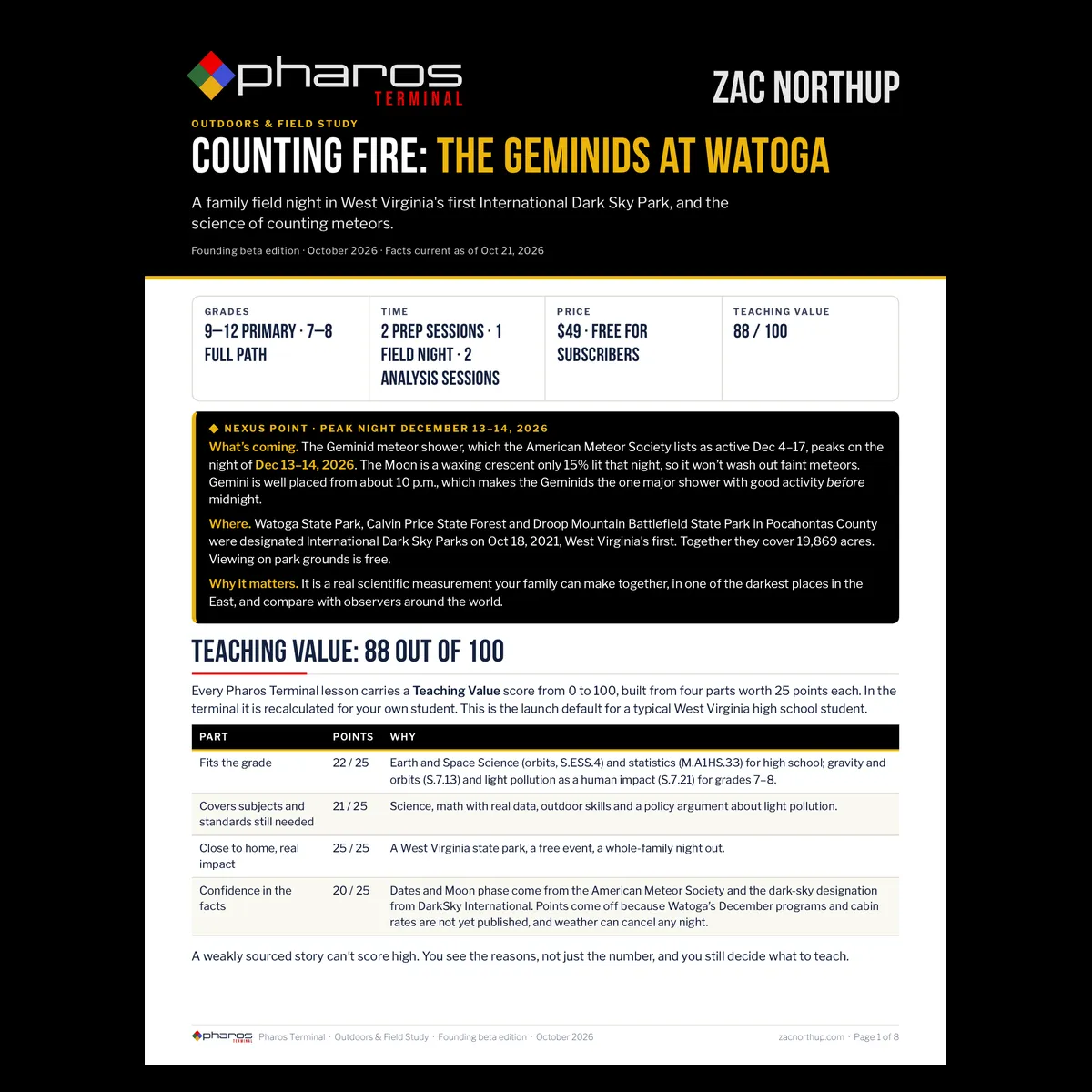
Counting Fire: The Geminids at Watoga
A family field night in West Virginia's first International Dark Sky Park, plus the real science of counting meteors. Two prep sessions, one night outside, two sessions of analysis.
Your student plans a real scientific count, takes it on the peak night of the Geminid meteor shower, Dec 13–14, 2026, and turns the tally into a result that can be checked against observers around the world. The packet is built around Watoga State Park in Pocahontas County, part of West Virginia’s first International Dark Sky Park. Viewing on park grounds is free. If you can’t make the trip, the count works from your own backyard and becomes a lesson in light pollution.
What’s inside
- Two prep sessions (50 minutes for high school, 40 for grades 7–8), one field night, and two analysis sessions (60 minutes for high school, 40–45 for grades 7–8).
- High school: a counting protocol and data sheet your student designs, four 30-minute counting blocks, and the zenithal hourly rate (ZHR) worked out from the count.
- Sources: the American Meteor Society calendar, the International Meteor Organization’s published results, and DarkSky International’s 2021 announcement of the designation.
- Writing task: a lab report plus a one-page argument on whether West Virginia should protect more dark-sky areas.
- A full grades 7–8 path: a flashlight-and-dust radiant demonstration, a Moon-phase model, a tally in 15-minute bins, a bar graph and a poster.
- Safety, cold-weather and planning notes, a word bank, rubrics and a portfolio record.
Grades and standards
Grades 9–12, with a full grades 7–8 path. West Virginia standards: S.ESS.4, S.ESS.18, M.A1HS.33, ELA.11.20, S.7.13, S.7.21, M.8.28.
Instant PDF download, $49. Included with a Pharos Terminal subscription.