

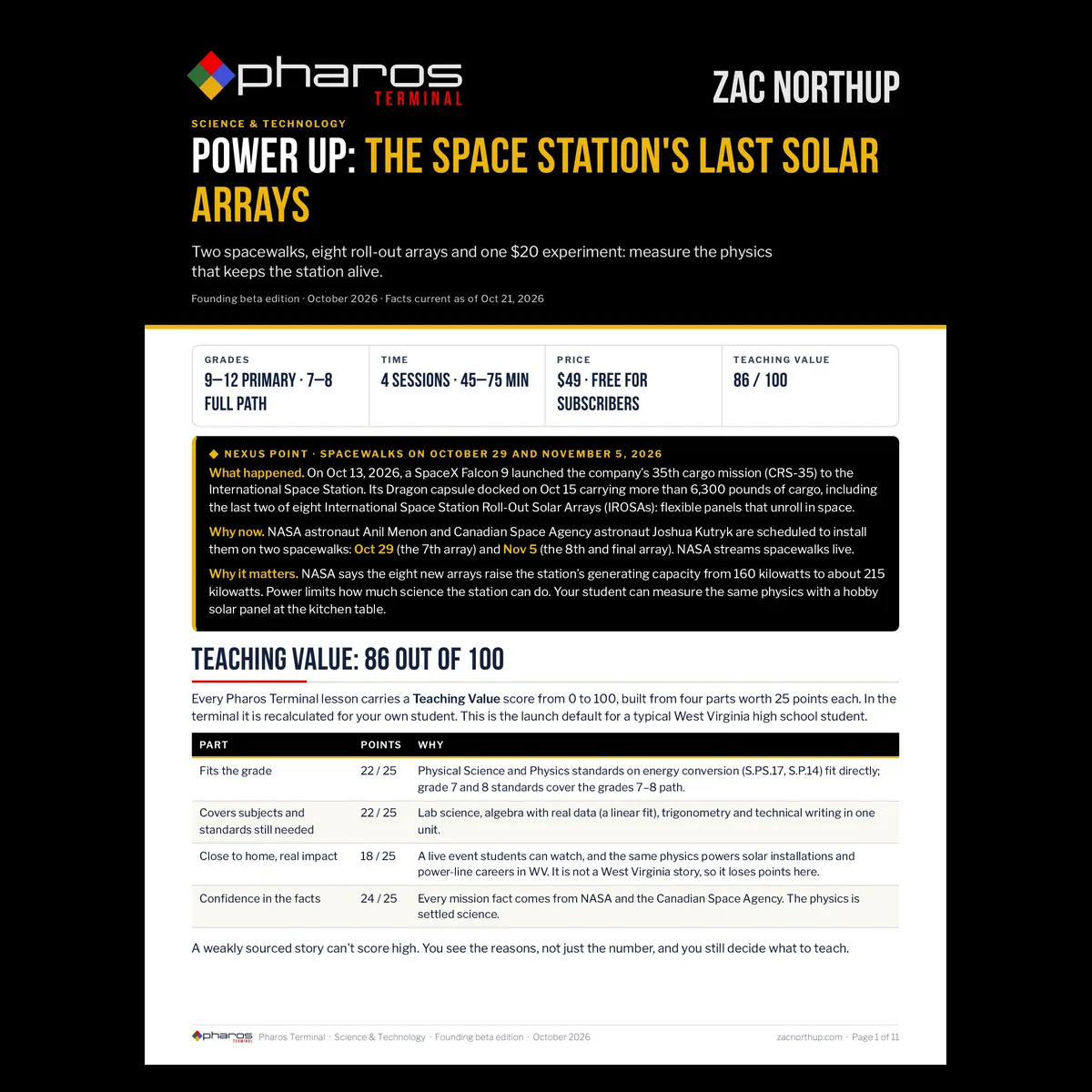
Power Up: The Space Station's Last Solar Arrays
Two spacewalks, eight roll-out arrays and one $20 experiment. Your student measures the physics that keeps the station alive.
This fall two spacewalks, on Oct 29 and Nov 5, 2026, are scheduled to install the last of eight new roll-out solar arrays on the International Space Station. NASA says the arrays raise the station’s generating capacity from 160 kilowatts to about 215. Your student reads NASA’s own reports, then measures the same physics at the kitchen table with a small hobby solar panel and a multimeter.
What’s inside
- Four sessions. High school sessions run 60–75 minutes; grades 7–8 sessions run 40–45 minutes.
- Sources: NASA and Canadian Space Agency mission facts, and NASA’s live or recorded coverage of the spacewalks.
- The Tilt the Array lab: current measured at different angles, plotted against cos θ, with a line of best fit. Shade and “orbit” tests follow.
- A one-time kit of about $20: a 5–6 volt hobby panel, a digital multimeter, a protractor, cardboard and tape.
- High school writing task: a 2–3 page lab report that ties the data to the station, with a 20-point rubric.
- A full grades 7–8 path with its own lab, a science notebook and a drawing of the station’s power system.
- West Virginia careers that use this physics, with state pay and job projections.
Grades and standards
Grades 9–12, with a full grades 7–8 path. West Virginia standards: S.PS.17, S.P.14, S.PS.29, S.P.22, S.ESS.4, M.A1HS.36, ELA.11.21, DSS.9-12.11, S.8.18, S.7.13, S.7.23, ELA.8.21.
Instant PDF download, $49. Included with a Pharos Terminal subscription.