

The Real Events That Shaped the Story
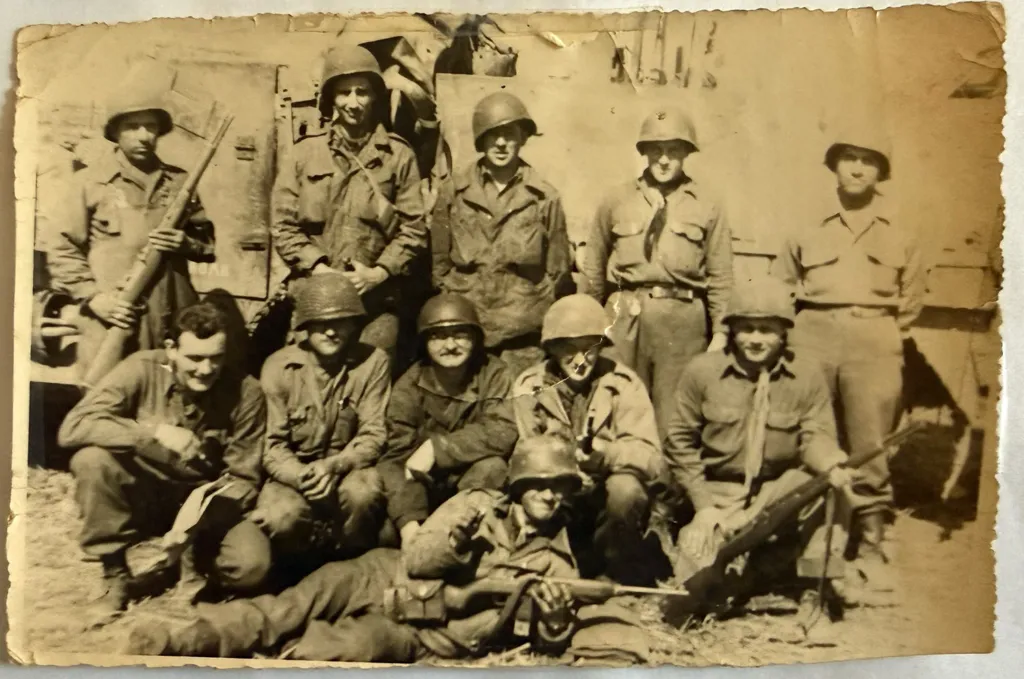
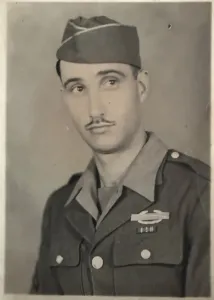 Growing up, I knew my grandfather served in the Second World War, but he never provided any details. Like most veterans of that conflict, he would speak of it when asked, but never brought it up in everyday conversation. Even though he sometimes said he hated the Army, his service defined him for the rest of his life. He attended every reunion he could until the year before he died. He kept his Combat Infantryman’s Badge framed next to his desk at home. He was buried with military honors. I still have the flag that draped his coffin, preserved in a display box in my office.
A couple of months before I started this book, my mother handed me a binder with his handwritten notes and photos from the war. For the first time, I had a detailed account of his combat experiences between 1944 and 1945. After arriving in Europe, he saw some of the worst fighting of the war. He fought in the Battle of the Bulge. His unit captured the Remagen Bridge over the Rhine. He fought his way across Germany and, with his friends, witnessed the horrors of the concentration camps.110
But he never spoke about the fighting. He didn’t want to. He didn’t need to. That was the way of his generation. They came home and tried to live the rest of their lives in peace.
There is a mountain of stories from World War II that need telling. This book is one small attempt to show current generations what men like my grandfather experienced. I chose to write it as fiction. Like Tim O’Brien’s book, The Things They Carried, I believe fiction can capture not only the facts of past events, but the emotions of the people who lived through them. It is impossible to understand war unless you can feel what those who fought it felt. That requires fictional dialogue and character development. I didn’t just want readers to know my grandfather’s story. I wanted them to feel it. That is why In the Ashes is written the way it is.
The result is a work of fiction in which some things are real and others are not. Every incident happened in some form. Some passages are composites drawn from his recollections and those of other veterans.
Eddie Hoskins is based on my grandfather, though I gave him a few traits from other personalities. His physical description and reserved demeanor are accurate. The moment on the bridge where Eddie shoots the old man is taken directly from my grandfather’s notes. 111
Some reviewers have mentioned how often Eddie chews tobacco in the story. Grandpa chewed Red Man almost until the day he died, and I wanted to leave that detail in.
The other members of the squad passed away many years ago. I never had a chance to interview them. Their emotions, motivations, and behaviors are not meant to reflect their true personalities. Though reasonable and logical, the confrontations and arguments in the story are entirely fictional. I know they all served honorably and attended reunions with my grandfather for decades. They were lifelong friends. They were all heroes.
Wilkins, Therese, David, and Elise are fictional, as is the quest to save Elise. I needed an inciting incident that created a realistic moral catalyst with real emotional stakes. Elise and David’s concentration camp plot line allowed me to incorporate more of my grandfather’s notes and memories. He was there. He saw what the Nazis did. He took photos and left them for me. The Holocaust was real.
The notes do not specifically mention Zwodau, but elements of the 9th Armored Division, along with the 1st Infantry Division, liberated the camp in May 1945. After-action reports and other primary sources place his battalion in the vicinity. That was enough for a work of fiction.
Because the women at Zwodau performed forced labor making parts for the Luftwaffe, most were found in reasonably good health compared to prisoners in the death camps. 112
Photographs in the archives of the United States Holocaust Museum show some of them wearing simple skirts and blouses, smiling with American soldiers.
I could offer more details, but I will leave it to the reader to decide what to believe. I encourage everyone to do their own research—to discover the truth of the war, the sacrifices of the men who fought it, and the terrible cost inflicted by the Nazis.
I would like to believe the world learned a permanent lesson from that war. It did not. We have lost too many of these stories and too much of the real history of the Second World War. I hope we can rediscover those lessons before we make the same mistakes again.
Zac Northup