
My AI Warning Label
AI is here to stay, and like every other profession, writers must adapt. I’ve accepted that.
I use AI as a tool — much like a powerful spell-checker or research assistant. It helps me catch errors, refine phrasing, fact-check details, conduct market research, and create marketing materials. I’ve also used it to generate virtual voices for audio samples on my website and short promotional videos.
However, there is one line I will not cross.
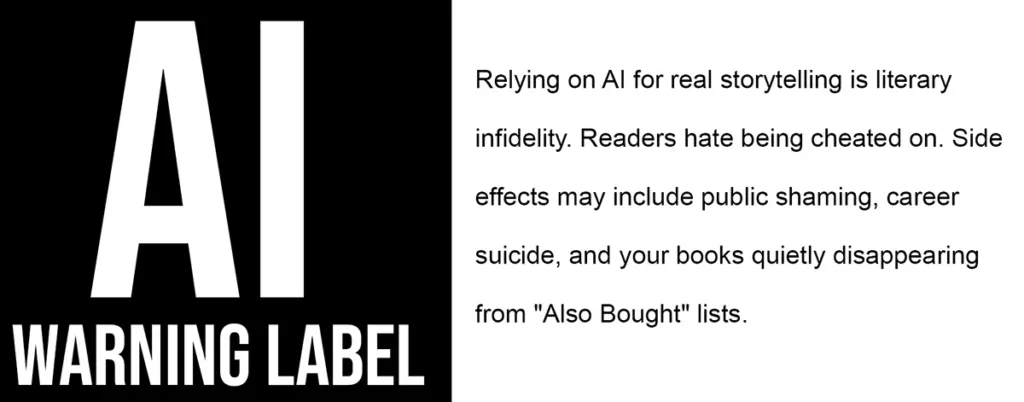
Readers expect — and deserve — an honest expression of the writer’s skill and imagination, especially in fiction. They also expect a genuine emotional connection to the characters. Generating that emotional resonance is one of a writer’s most important responsibilities. When AI is used to create characters, plots, themes, or emotional depth, it breaks the implicit contract between writer and reader. I consider that literary infidelity.
That principle guides how I use AI. Here’s exactly where I draw the line:
How I Use AI:
- Check spelling, grammar, and punctuation
- Proofread for clarity and intent
- Fact-checking and limited historical research (primary sources and books remain primary)
- Market research and trend analysis
- Creating marketing visuals and collateral
- Website development and optimization
- Generating virtual voices for website audio samples only
- Producing short promotional videos
Everything else — the concept, the storytelling, the characters, the emotional truth, and the creative decisions — remains entirely human.
This approach ensures that when you read my work, you’re getting my best effort as both a craftsman and a human being.



Services
Information
© 2025 Zac Northup. All Rights Reserved.