
Civics course
Thorough and Efficient: How Education Law Is Made
12-Lesson Civics Course · Grades 7–12, high school first
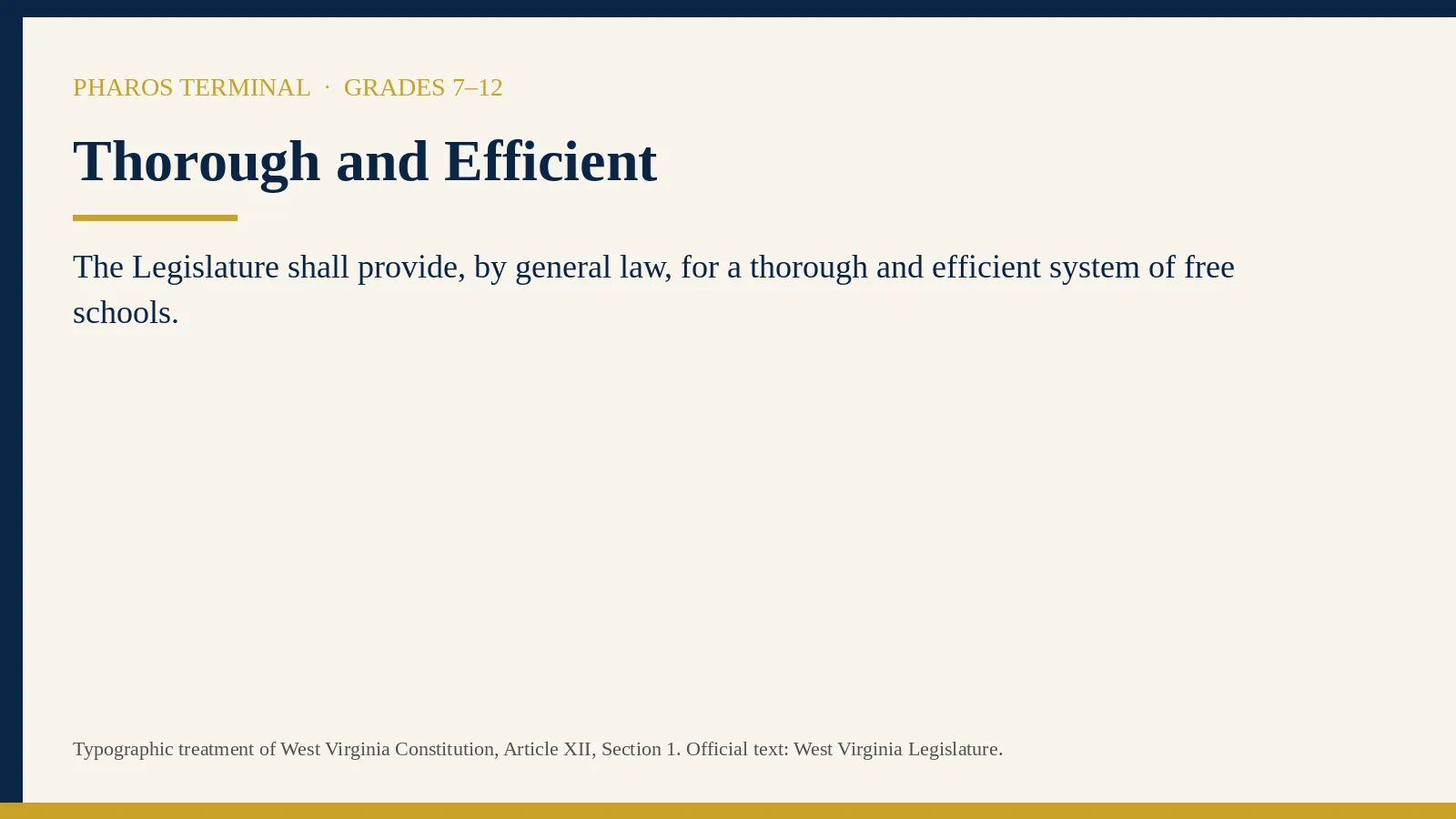
The record, from the official text
Students read constitutions, statutes, court opinions, and official agency reports as they were published, and they name the trade-offs in each choice. Historical cases stay in their year. Current bills, proposed rules, and living officials are dated and are not treated as final law or as featured protagonists.
For the parent or teacher
Each lesson’s parent note says what to preview that day, and every lesson has a full answer key.
Course Big Question
Who decides how schools are paid for, what rights do families have to teach at home, and what does each choice cost?
Course introduction
Read the document, then name the trade-off. This course teaches how education law is made and changed: in constitutions, statutes, committees, courts, and school boards, and what those rules mean for families who teach at home. Students read primary texts first. They define contested terms before argument is allowed to run ahead of them. They steel-man each side of the public-school funding debate, the Hope Scholarship debate, and the homeschool-regulation debate, and they judge policies by measured outcomes, not by stated intentions.
Complementary, not a remake. The course sits beside The Constitution: Founding the Republic, 1776-1791 (the founding) and Take Care: The American Presidents and the Power They Hold (the presidency). It does not retell those courses. Current 2026-27 cases, bills, and federal notices appear only as dated case studies or dated proposals. Living officials are not featured as protagonists.
A civic brief, not a campaign piece. The capstone is a short sourced brief with a fixed definition, a testable claim and what would falsify it, a steel-manned objection, and an explicit trade-off (who gains, who pays, what is given up).
Twelve lessons, including a capstone. Students read constitutions, statutes, court opinions, and official reports, then write a civic brief that names who decides and what each choice costs.
Grades 7–12, high school first. A suggested 6-week pace, two lessons a week of about 55 minutes, plus the week’s reading. Aligned to West Virginia Department of Education academic standards.
The course opens with an active Pharos Terminal subscription.
The course opens with an active Pharos Terminal subscription.
Subscribe to start Lesson 1 Already a subscriber? Sign in
Pharos Terminal
Every course is included
This course is included with an active Pharos Terminal subscription, along with every other course, new courses as they’re released, a new Nexus Point every day and the parent tracker. Lessons are aligned to West Virginia Department of Education academic standards in English Language Arts, Science and Social Studies.