
History course
The Constitution: Founding the Republic, 1776–1791
12-Week History Course
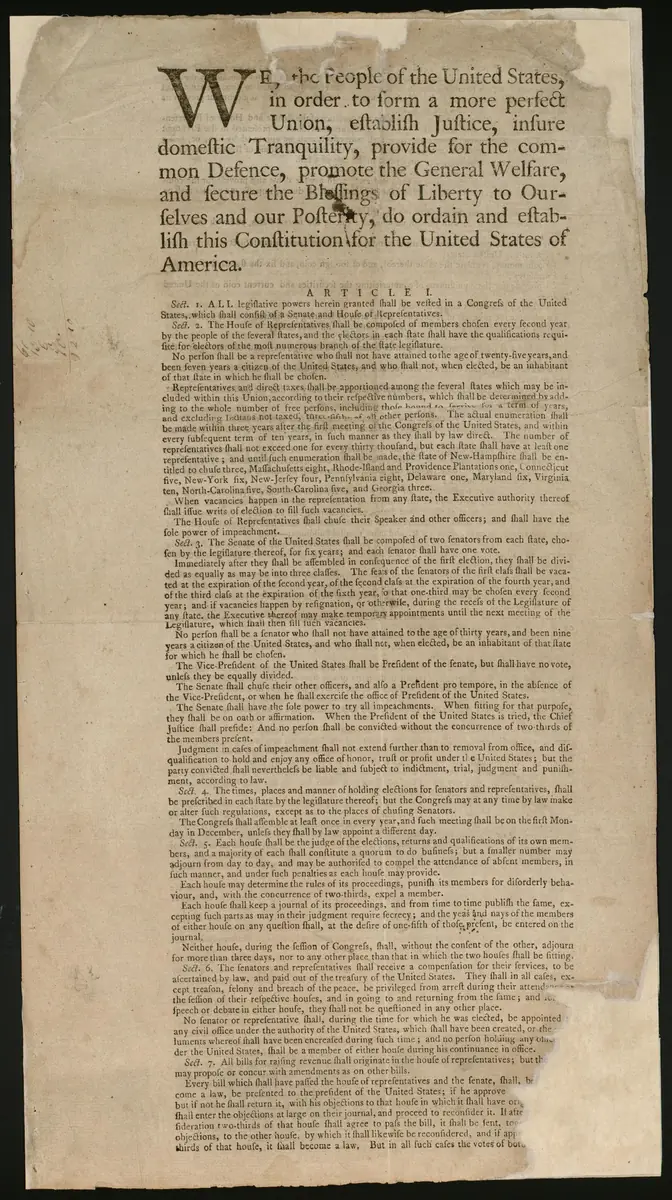
The record, from every side
Your student reads the Constitution and the debates that made it: the Articles, Madison’s notes of the Convention, the Federalist and Anti-Federalist essays, the ratification votes, and the first Congress. The framers and their opponents are each stated in their own documents’ terms, in the setting of their own day, and every claim traces to a source printed in the lesson.
For the parent or teacher
Parent notice: what each part of the course contains, so you can preview it first.
- Weeks 4–6. Parent notices: Lesson 8 (the Massachusetts rising of 1786–87, both the Regulators’ and the state’s case), Lesson 11 (the Convention’s bargains, including the slave trade and fugitives, taught from the August 1787 debates in the terms of 1787). Plain, not graphic. Unit test in Week 6.
- Weeks 9–11. Parent notices: Lesson 18 (the Anti-Federalist case, including a standing army and the want of a bill of rights), Lesson 19 (Virginia’s 89–79 vote). The course ends with the Bill of Rights’ ratification on December 15, 1791, and the bank opinions of February 1791. The rising in the west in 1794 is out of scope.
Each lesson’s parent note says what to preview that day, and every lesson has a full answer key.
Course Big Question
How do you build a government strong enough to hold a union together and limited enough to protect liberty?
Course introduction
What was new. Most students can name the three branches but have never read the Articles, Madison’s notes or the ratification debates, and so never see how new the Constitution was: a written frame of government created by the people, divided between nation and states, separated and checked, ratified by conventions, and amendable by its own rules. This twelve-week course follows 1776 to 1791 in the words of the framers and their opponents. It works if each student can explain, article by article, what the Constitution does, why its design was unprecedented, and argue both sides of ratification from the record.
Every side in its own words. The framers, their opponents, the state conventions, and the first Congress and President are each read in their own documents. The Anti-Federalist case is stated first, in its own words, before it is answered. The bank opinions of February 1791 are given the same way: Jefferson’s construction, then Hamilton’s.
Sources first. Every lesson opens with a period document: Magna Carta and the English Bill of Rights, the Declaration, the first state constitutions, the Articles, the Northwest Ordinance, Madison’s notes, the Constitution as printed in 1787, Wilson, The Federalist, Brutus, Centinel, the Federal Farmer, Mason and Warren, the ratification votes, Washington’s inaugural, the Judiciary Act, the Bill of Rights, Hamilton’s report on public credit, the first census Return, and the bank opinions. Catherine Drinker Bowen’s Miracle at Philadelphia supports Madison’s notes in Weeks 5–7; it does not replace them.
From the first state constitutions and the Articles of Confederation to the Convention of 1787, ratification, the first Congress and the Bill of Rights, in seven units. Every writing task has its own expectations for the Grades 7–8 path, Grades 9–10 and Grades 11–12. There are document and map quizzes, two DBQs, a unit test in Week 6 and a final in Week 12, and the capstone project is presented in Week 12.
Grades 9–12, with a Grades 7–8 path. 12 weeks, two lessons a week of about 55 minutes, plus the week’s reading in the course books. Aligned to West Virginia Department of Education academic standards (Social Studies and English Language Arts, grades 8–12).
The course opens with an active Pharos Terminal subscription.
Subscribe to start Lesson 1 Already a subscriber? Sign in
Pharos Terminal
Every course is included
This course is included with an active Pharos Terminal subscription, along with every other course, new courses as they’re released, a new Nexus Point every day and the parent tracker. Lessons are aligned to West Virginia Department of Education academic standards in English Language Arts, Science and Social Studies.