
Literature course
Hemingway at War
7-Week Literature Course
Literature beside the record
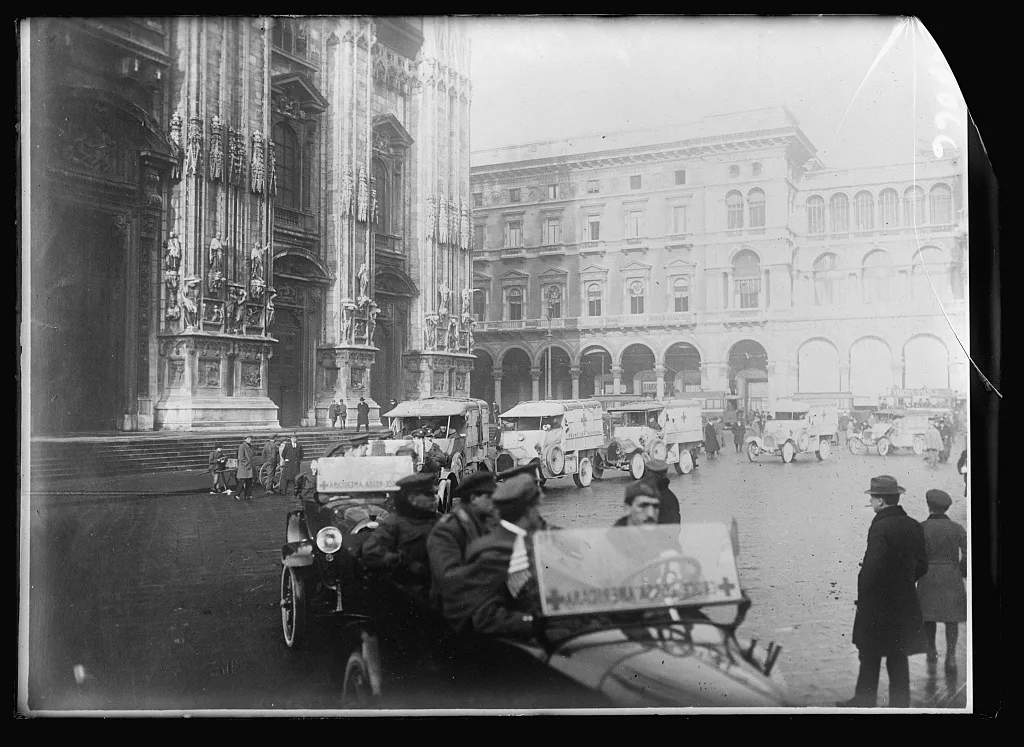
Every lesson reads the chapters in the novel and sets them beside the record of the two wars: American Red Cross photographs from the Italian front, photographs of the young Hemingway, the war poets, Scripture, a 1937 act of Congress and short context cards written for the course. A Farewell to Arms is quoted from the public-domain 1929 text; For Whom the Bell Tolls is still under copyright, so the lessons describe it in their own words.
For the parent or teacher
These are war novels for mature readers. They include the deaths of soldiers and civilians, heavy drinking and swearing, a stillbirth, a mob killing told at length (For Whom the Bell Tolls, Ch. 10; grade 10 students may read the course’s guide summary instead) and a young woman’s memory of rape, told without detail, and a father’s suicide, remembered. None of it is graphic. Parent notice: both novels include scenes in which the lovers sleep together. In For Whom the Bell Tolls, Jordan and Maria make love in Ch. 7, 13, 20 and 37 (Lessons 18, 20, 23 and 28); in A Farewell to Arms, Frederic and Catherine’s relationship is implied, never described (Lessons 5, 6, 7, 10 and 11). Neither novel describes these scenes in graphic detail, but it is clear what is happening, and each of those lessons carries its own notice. Lessons 1 and 16 carry the full content preview for each unit, each flagged lesson says what to preview, and every lesson has an answer key and discussion guidance.
Course Big Question
What does war cost the men who fight it, and what can they keep?
Course introduction
Two wars, one writer. In June 1918, Ernest Hemingway, eighteen years old, arrived on the Italian front as an American Red Cross volunteer, and on the night of July 8 he was badly wounded by an Austrian trench-mortar shell near Fossalta di Piave. Eleven years later he published A Farewell to Arms (1929). In 1937 he went back to war as a reporter in Spain, and in 1940 he published For Whom the Bell Tolls. Over seven weeks your student reads both novels and studies what war does to the men inside it, and how the Great War shaped the writers called the Lost Generation.
One question. The course asks: What does war cost the men who fight it, and what can they keep? Frederic Henry makes what he calls a separate peace and walks away from his war. Robert Jordan stays at the bridge. Between them stand two lines your student will weigh: Hemingway’s “The world breaks every one and afterward many are strong at the broken places,” and John Donne’s “any man’s death diminishes me, because I am involved in mankind.”
The record beside the novels. Each day begins with a source: American Red Cross photographs from the Italian front, photographs of the young Hemingway, the poems of Wilfred Owen and John McCrae, Fitzgerald and Dos Passos, Ecclesiastes and Donne, a 1937 act of Congress, and short context cards written for the course. Students define contested words like courage before they argue about them, state the strongest opposing view before they answer it, judge choices by their results, and hold every side and every army to the same standard. The course reads with a Christian worldview, and it puts the questions the novels raise about sin, love, killing and death beside Scripture.
How it works. Thirty-five lessons of about 105 minutes, in two units: The Great War (weeks 1–3) and Spain (weeks 4–7). Every grade reads both novels. Every day has a short writing task with separate expectations for grades 10, 11 and 12, and parent pages with what to say, what to ask, what to listen for and an answer key. There is a short essay and a unit essay in Unit 1, and a short essay and a final essay on both novels in Unit 2. Aligned to West Virginia Department of Education academic standards (English Language Arts, grades 9–12). The related lesson packet The Wounded and the Words: A Farewell to Arms matches five lessons in Unit 1. The course is included in the Pharos Terminal subscription.
A Farewell to Arms and For Whom the Bell Tolls. Your student reads both novels, a lesson a day, with a short writing task every day, short essays in each unit and a four-lesson capstone essay on both novels.
Grades 10–12, 7 weeks, one lesson a day of about 105 minutes, including the reading (a few writing days run about 2 hours). Aligned to West Virginia Department of Education academic standards (English Language Arts, grades 9–12). Each family needs its own copy of For Whom the Bell Tolls; any complete edition works.
The course opens with an active Pharos Terminal subscription.
Subscribe to start Lesson 1 Already a subscriber? Sign in
Pharos Terminal
Every course is included
This course is included with an active Pharos Terminal subscription, along with every other course, new courses as they’re released, a new Nexus Point every day and the parent tracker. Lessons are aligned to West Virginia Department of Education academic standards.